
Astro Bot was one of those experiences that caught me completely off guard. Not because I expected a bad game — far from it. After Astro's Playroom, I already knew Team Asobi had the talent to create fun, personality-filled platformers. What I didn't expect was to find a game so refined, so creative, and so constantly surprising that it made me completely rethink the Game of the Year conversation.
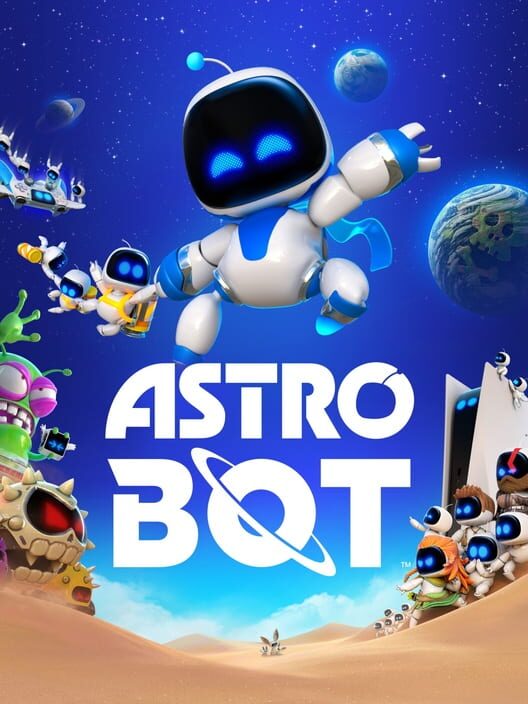
I confess that when the first discussions about Astro Bot as a potential contender for the industry's biggest awards began, I looked at the situation with some skepticism. After all, we were talking about a platformer in a market dominated by gigantic RPGs, cinematic adventures, and productions with astronomical budgets.
After playing it, I understood exactly why so many people placed it at that level.
Astro Bot doesn't try to reinvent video games. It doesn't seek to create a revolutionary narrative or present mechanics impossible to understand. Instead, it does something many modern productions seem to have forgotten: it focuses obsessively on being fun.
And it pulls that off brilliantly.
From the very first minutes, it's impossible not to be impressed by the level of creativity present in every moment of the adventure. Every planet, every level, and every new mechanic seems designed with a single question in mind: "How can we make the player smile?"
The answer arrives constantly throughout the campaign.
Just when we think we've seen everything the game has to offer, a new idea appears. Just when we assume a certain mechanic will stick with us for several hours, the game presents something completely different. There's an impressive capacity for constant renewal that keeps Astro Bot from ever becoming predictable.
It's precisely that inexhaustible creativity that sets it apart from most games in the genre.
The levels are packed with little surprises, unexpected moments, and concepts that could easily serve as the foundation for entire games of their own. Team Asobi, however, prefers to present those ideas, explore them at exactly the right moment, and move on before they lose their impact.
The result is an adventure that permanently maintains a strong sense of discovery.
Visually, Astro Bot is absolutely fantastic.
The art direction finds a perfect balance between visual spectacle and its own identity. The worlds are colorful, vibrant, and full of personality, but never feel overloaded or confusing. Each environment has unique characteristics and a well-defined visual identity, making exploration constantly rewarding.
There's an extraordinary level of care in the small details. From the character animations to the elements scattered across the scenery, everything conveys a sense of quality and attention to the tiniest touches.
It's one of those games that occasionally makes us stop just to observe what's happening around us.
But while the visuals impress, the use of the DualSense remains one of Team Asobi's greatest demonstrations of strength.
Just like in Astro's Playroom, the PlayStation 5 controller isn't used merely as a traditional accessory. Every vibration, every bit of resistance in the adaptive triggers, and every tactile interaction contributes to deepening the immersion.
Walking across different surfaces, using specific abilities, or interacting with the environments gains an extra dimension thanks to the excellent work done with the DualSense.
Even several years after the PS5's launch, few games manage to use the controller's features with this much creativity and effectiveness.
The gameplay is simply delightful.
The controls are precise, responsive, and extremely intuitive. Astro responds exactly the way we expect, making every jump, run, or maneuver a natural extension of our intentions. There's a constant fluidity that makes playing always pleasant, regardless of the challenge ahead.
At the same time, the game manages to be accessible to new players without sacrificing the depth needed for those looking to master all its systems and complete every challenge.
That's one of its greatest qualities.
Astro Bot can please practically anyone. It's a game that can be enjoyed by children, casual players, and industry veterans alike, without ever compromising its identity.
Naturally, for PlayStation fans there's an additional layer of enjoyment.
Much like Astro's Playroom, this adventure also functions as an enormous celebration of the brand's history. Throughout the campaign we encounter dozens of references to characters, consoles, and iconic moments from the PlayStation universe.
But what I enjoyed most was how those tributes are integrated.
They never feel forced. They never appear just to provoke easy nostalgia. They're part of the game's world and identity in a natural way, working as small rewards for anyone who recognizes those historic moments.
It's impossible not to smile when coming across some of those references scattered through the levels.
The narrative is simple, but it fulfills its role perfectly.
Astro embarks on a mission to rescue the remaining Bots and rebuild his ship after an unexpected attack. We're not looking at a complex or particularly deep story, but I never felt it needed to be one.
The adventure understands perfectly what it sets out to achieve.
The narrative serves as a starting point for exploration and for the levels' creativity, without ever interrupting the gameplay's rhythm or trying to claim an unnecessary spotlight.
And honestly, it works perfectly.
The soundtrack also deserves recognition.
The music accompanies each world in exemplary fashion, helping reinforce each environment's distinct identity. There are energetic tracks that elevate the most frenetic moments and lighter melodies that perfectly complement the exploration sections.
It's yet another element demonstrating the enormous care placed into every aspect of the production.
Throughout the adventure, I caught myself several times comparing it to Super Mario Odyssey. Not because Astro Bot tries to copy Nintendo's formula, but because it conveys a similar feeling of constant joy — that rare sensation of playing something created by a team that genuinely loves video games and understands what makes this medium so special.
And here comes perhaps the boldest statement I can make.
Super Mario Odyssey remains an absolute masterpiece of the genre. But personally, I had even more fun with Astro Bot.
Maybe because of the freshness of its ideas. Maybe because of the emotional connection to the PlayStation references. Maybe simply because Team Asobi managed to create an experience so carefully constructed that it became impossible not to be won over by it.
In the end, Astro Bot is much more than an excellent platformer.
It's a celebration of creativity. A demonstration of the power of simplicity when executed with excellence. A passionate tribute to PlayStation's history. And, above all, an adventure that reminds us why we love video games so much.
Few games manage to convey this much joy in every minute of gameplay. Even fewer manage to do it with this much consistency.
If Astro Bot is Team Asobi's future, then we're looking at a studio capable of creating some of this industry's most special experiences.
And if Astro keeps evolving this way, I have no difficulty imagining him as one of the great mascots of modern video games.
Because after this adventure, he's no longer just the PlayStation's friendly little robot.
He's a star in his own right.
out of 10
Pros
| Cons
|
Game Astro Bot Released 2024 Available on PlayStation 5 Reviewed on PlayStation 5 |  Cover: IGDB |
| PL | Pedro Lopes Writer · Portugal |
A games writer from Portugal running on a highly irresponsible amount of coffee — his blood type is officially "espresso". He has been a content creator at Lisbon Games Week, a jury member at Over & Out ’25 and an attendee of DevGAMM Lisbon 2025 (mostly for the free coffee). He has a Pac-Man tattoo on his finger, which contractually obliges him to chase ghosts forever.