
There are bad games. There are mediocre games. There are games that simply pass by unnoticed and vanish from memory a few days after we finish them. And then there's Jumanji: The Video Game — an experience so peculiar it almost deserves to be studied as a phenomenon of its own.

Usually, when I write a review, I always try to find a balance between positives and negatives. Even the most problematic games typically have at least one or two interesting ideas, some element that shows potential, or a quality that helps justify their existence. With Jumanji: The Video Game, I admit that task proved particularly challenging.
Based on one of the most popular film franchises of recent years, it would be reasonable to expect a fun co-op adventure, full of memorable moments, exploration, humor, and action. After all, the films managed to reinvent the brand for a new generation in surprisingly competent fashion.
The game, unfortunately, seems to have been handed a completely different map.
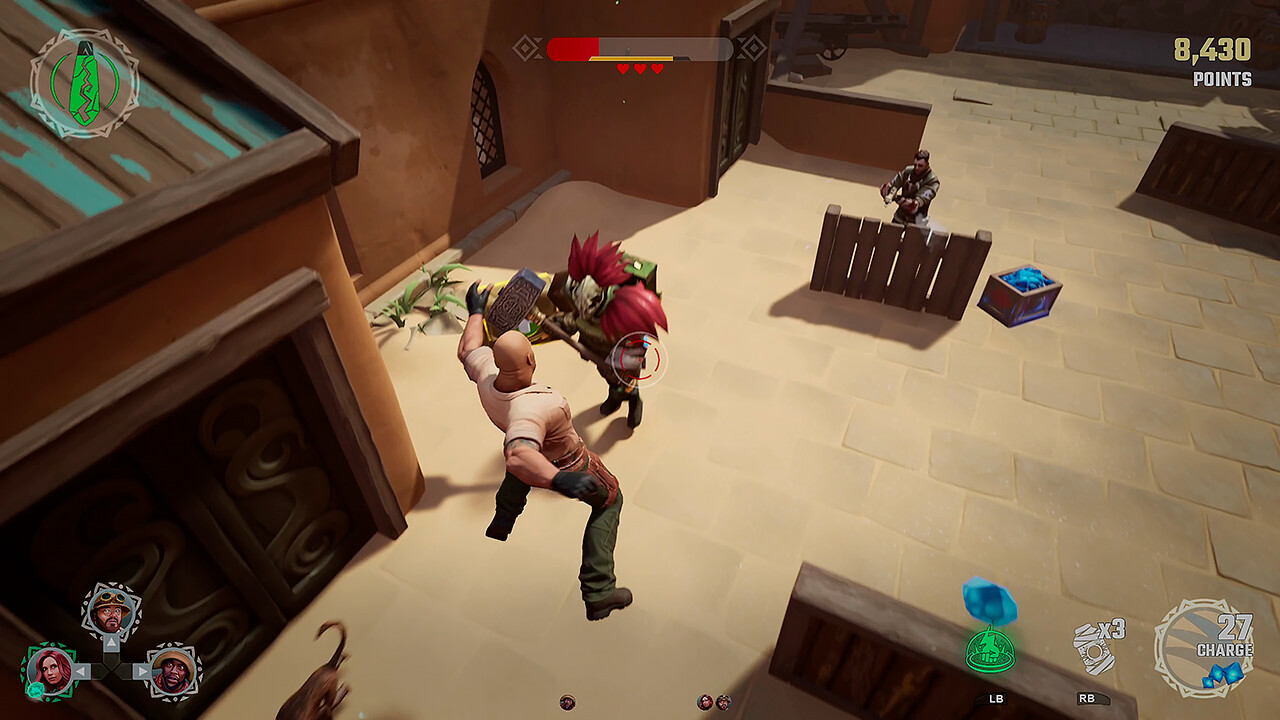
Repetitiveness is, without question, one of its most defining traits. Each level achieves the impressive feat of looking like a slightly altered copy of the one before it. The sense of progression exists only because the mission numbers keep changing. Otherwise, it would be perfectly possible to believe we're repeating the exact same experience over and over again.
There's almost a certain artistic courage to this approach. While many games constantly try to surprise the player with new mechanics, challenges, or settings, Jumanji opts for a much simpler philosophy: "Did you enjoy the last twenty minutes? Excellent. Here are five more hours of it."
Combat follows a similar logic. Enemies appear in generous quantities, but rarely offer any kind of interesting challenge. The AI seems to have been designed with the goal of never causing the player any real stress. And when I say never, I really do mean never.
Opponents move through the scenery with all the urgency of someone who just finished an enormous lunch and decided to take a digestive stroll. Their strategies are so predictable that after a few minutes we can already anticipate practically everything they're going to do.
There's something almost comforting about that predictability. Not because it's fun, but because it eliminates any possibility of surprise.
The voice acting also deserves a chapter of its own.
The performances manage to reach a rare level of enthusiasm-free delivery. At certain moments I was genuinely unsure whether the actors were playing characters or simply reading the instruction manual for a microwave.
Lines arrive without energy, without emotion, and without any apparent attempt to create a connection with the player. It's an experience that adds an extra layer of strangeness to an adventure that was already having enough trouble holding your interest.
The narrative doesn't help matters much either. There's a story, technically speaking. Characters exist. Objectives too. But everything seems to serve merely as an excuse to move on to the next batch of generic enemies and familiar scenery.
Perhaps one of the biggest compliments I can pay the game is its relatively short length.
Usually, when a game ends too quickly, that's seen as a problem. Here, it works almost as an act of mercy. The adventure manages to conclude before the repetition becomes completely unbearable — which is perhaps one of the smartest design decisions in the entire experience.
But not everything is completely negative.
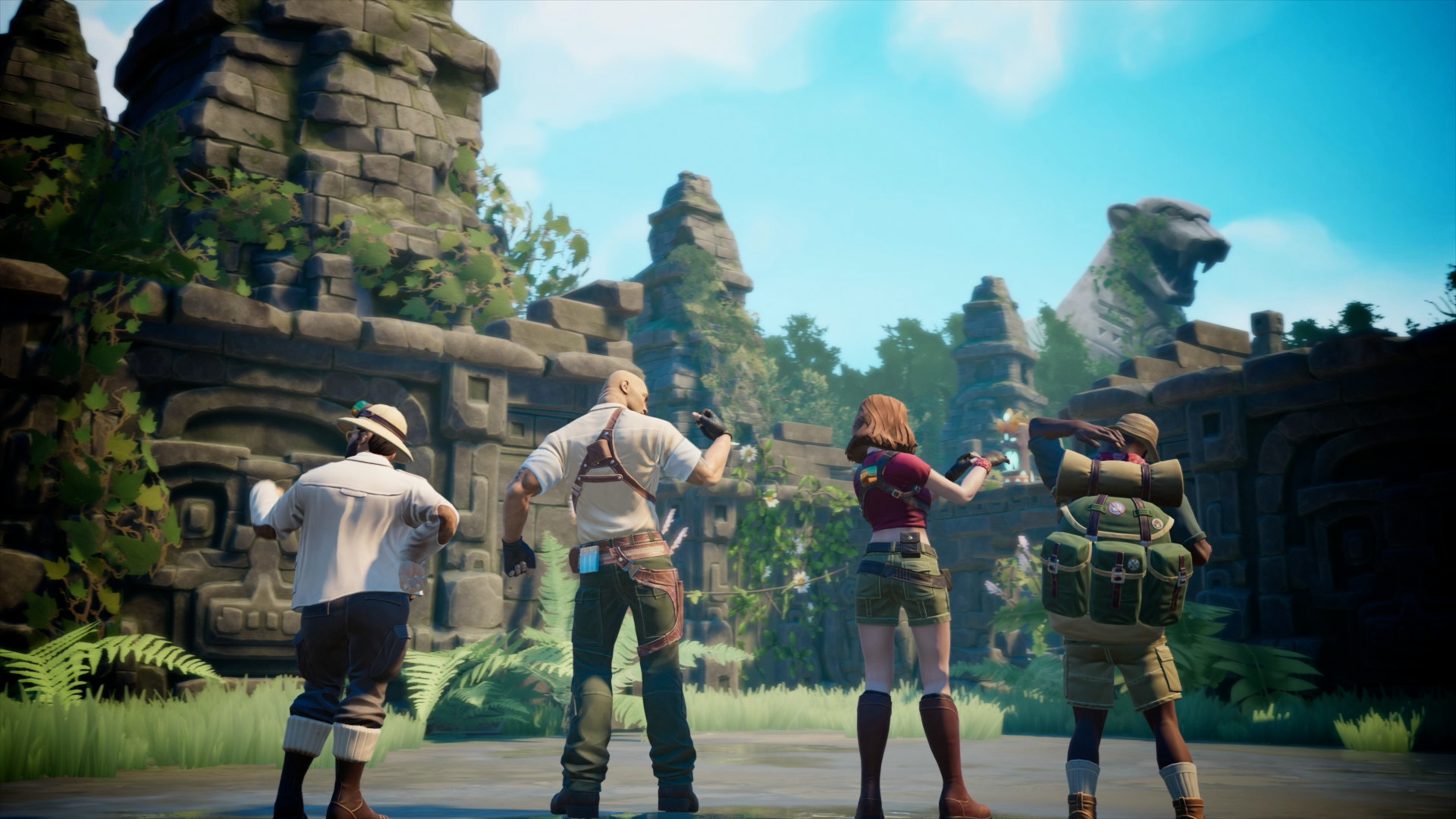
The visuals are probably the most competent element of the package. We aren't looking at anything particularly impressive, but the environments manage to capture at least a little of the adventurous spirit associated with the Jumanji universe. There are some pleasant settings to explore and, occasionally, we come across small moments where we glimpse the potential this adaptation could have had.
And that's precisely what ends up being most frustrating.
The potential was there.
The idea of a co-op game based on Jumanji makes perfect sense. The universe allows for exotic adventures, charismatic characters, humor, exploration, and action. In the right hands, it could have resulted in an enormously fun experience to play with friends.
Unfortunately, what we received feels closer to a project that never managed to decide exactly what it wanted to be.
I've had the chance to try indie games made by small teams, academic projects developed by students, and prototypes built with extremely limited resources that showed more ambition, creativity, and personality than what we find here.
And maybe that's what makes Jumanji: The Video Game so disappointing.
Not because it's offensively bad in every respect. Not because it's stuffed with catastrophic bugs or absurd decisions. But because it constantly conveys the feeling that nobody wanted to take a risk, innovate, or go beyond the bare minimum required.
In the end, Jumanji: The Video Game ends up being a memorable experience for all the wrong reasons — an adaptation that wastes nearly all the potential of the license it represents and rarely finds ways to justify the time the player invests.
It's the kind of game that can hardly provoke anger. It isn't bold enough for that.
It provokes something perhaps worse: indifference.
And for an adventure inspired by a universe known for chaos, unpredictability, and fun, that ends up being the greatest possible defeat.
A true journey into Jumanji... where the greatest danger isn't the jungle, nor the wild animals, nor the traps. It's simply the boredom.
out of 10
Pros
| Cons
|
Game Jumanji: The Video Game Released 2019 Available on PC · PlayStation 4 · PlayStation 5 · Xbox One · Nintendo Switch Reviewed on PlayStation 5 |  Cover: IGDB |
| PL | Pedro Lopes Writer · Portugal |
A games writer from Portugal running on a highly irresponsible amount of coffee — his blood type is officially "espresso". He has been a content creator at Lisbon Games Week, a jury member at Over & Out ’25 and an attendee of DevGAMM Lisbon 2025 (mostly for the free coffee). He has a Pac-Man tattoo on his finger, which contractually obliges him to chase ghosts forever.