
Untitled Goose Game is one of those games whose premise, the first time you hear it, sounds like an idea born from a joke among friends. After all, how many games exist where the main objective is simply to be a nuisance? And not just any nuisance. Here we control a goose whose mission seems to be turning the lives of an entire village into a veritable nightmare.
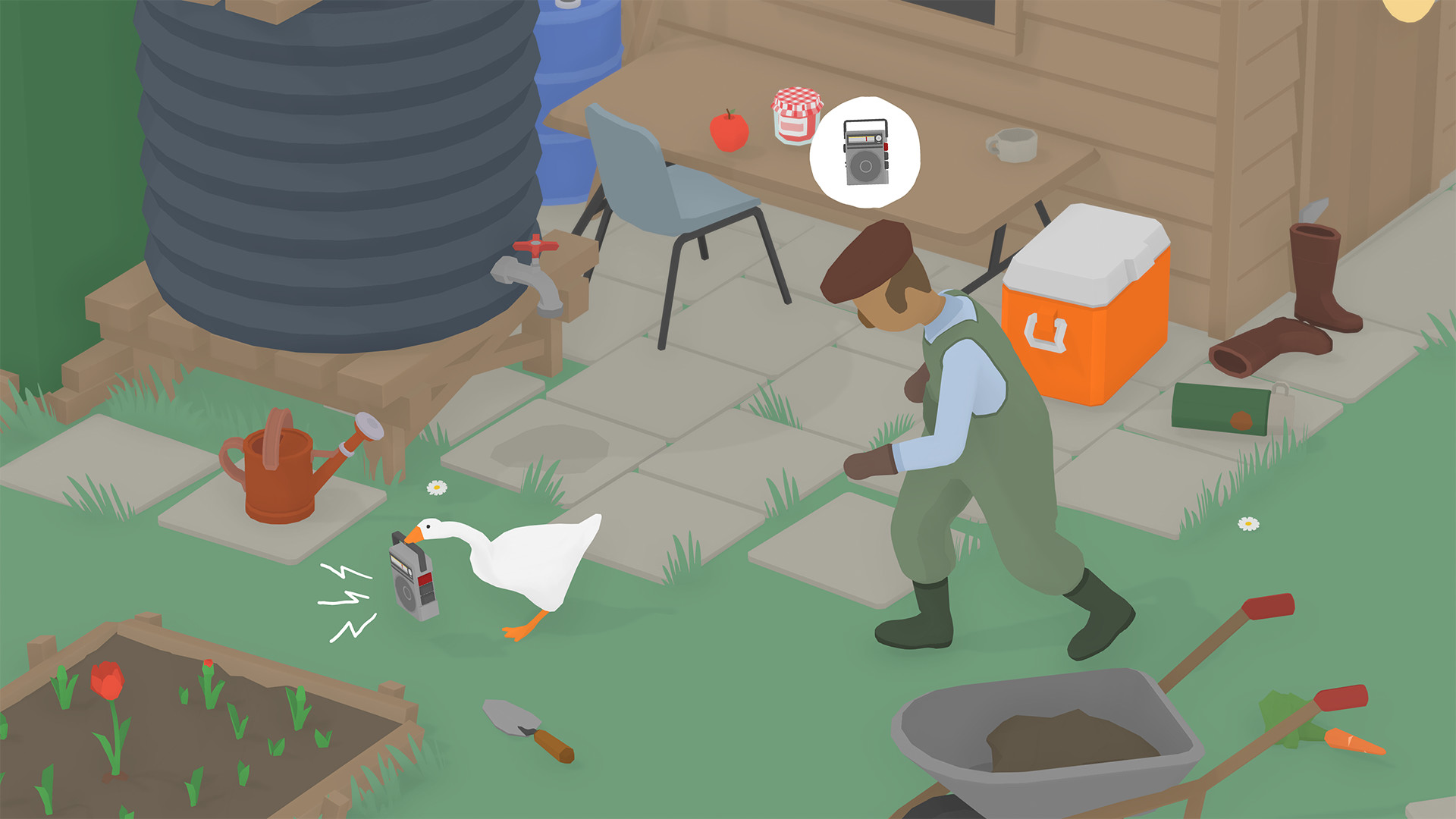
The curious thing is that what could easily have been a five-minute joke becomes a surprisingly fun and memorable experience. From the very first moments, the game understands exactly what it wants to be and never pretends to be something different. There's no grand narrative, no heroes to save, no worlds to explore. There's only a goose and an uncontrollable desire to cause as much mayhem as possible.
Much of the charm is born precisely from that simplicity. We're dropped into a quiet little village where the inhabitants are trying to live their lives normally. The problem is that we're there to make sure that doesn't happen. Stealing objects, hiding tools, locking people out of their own shops, or simply showing up at the wrong moment to ruin someone's day quickly becomes a hilarious routine.
What surprised me most was how the game makes us laugh without resorting to dialogue or traditional jokes. Much of the humor emerges from the situations we create. There's something genuinely comic about watching a villager desperately search for an object we've just hidden, or seeing them chase after us while we flee triumphantly with yet another stolen item in our beak.
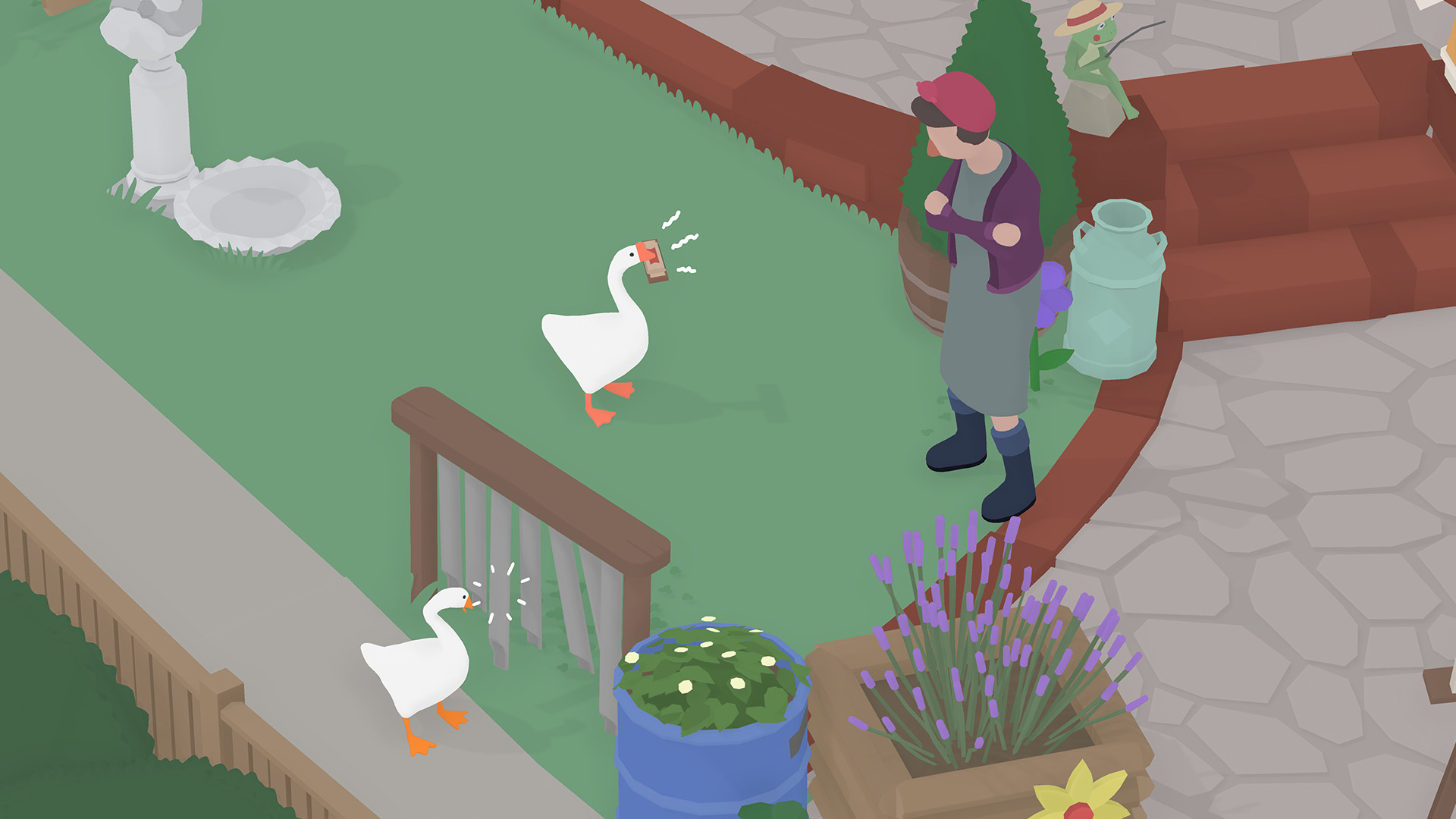
Visually, Untitled Goose Game takes a very simple but extremely effective approach. The art style resembles an interactive children's book, with soft colors, clean scenery, and characters that remain expressive despite their simplicity. It doesn't try to impress through realism or technical detail. The goal is to create a welcoming, pleasant environment that contrasts with the chaos we're constantly causing.
That art direction ends up working perfectly because it reinforces the game's unique personality. Everything looks calm, friendly, and peaceful... until we arrive. The contrast between the relaxing setting and our absurd actions is one of the reasons so many situations land as well as they do.
Another major highlight is the soundtrack. Instead of being constantly present, the music emerges dynamically and follows our actions. Piano melodies speed up while we're fleeing or creating problems, and become more discreet during exploration. It's a simple detail, but one that adds enormously to the comedy of each situation.
The gameplay is extremely accessible. The controls are simple, and anyone can quickly understand what they can do. We can run, pick up objects, drag them to other locations, open certain doors and, of course, honk whenever we feel like it. And the truth is, we soon realize that honking is a far more useful tool than it appears.
Each area presents a list of objectives that serves as a guide for progression. However, the way to complete them is rarely straightforward. We're often required to observe the inhabitants' behavior, understand their routines, and find creative ways to manipulate them to achieve what we want.
It was precisely this puzzle component that appealed to me most. Although the concept seems simple, there's enormous pleasure in discovering the solution to certain challenges. Some require only observation, while others demand combining several actions in a specific sequence. When we finally pull off a particularly elaborate plan, the sense of satisfaction is surprisingly big.
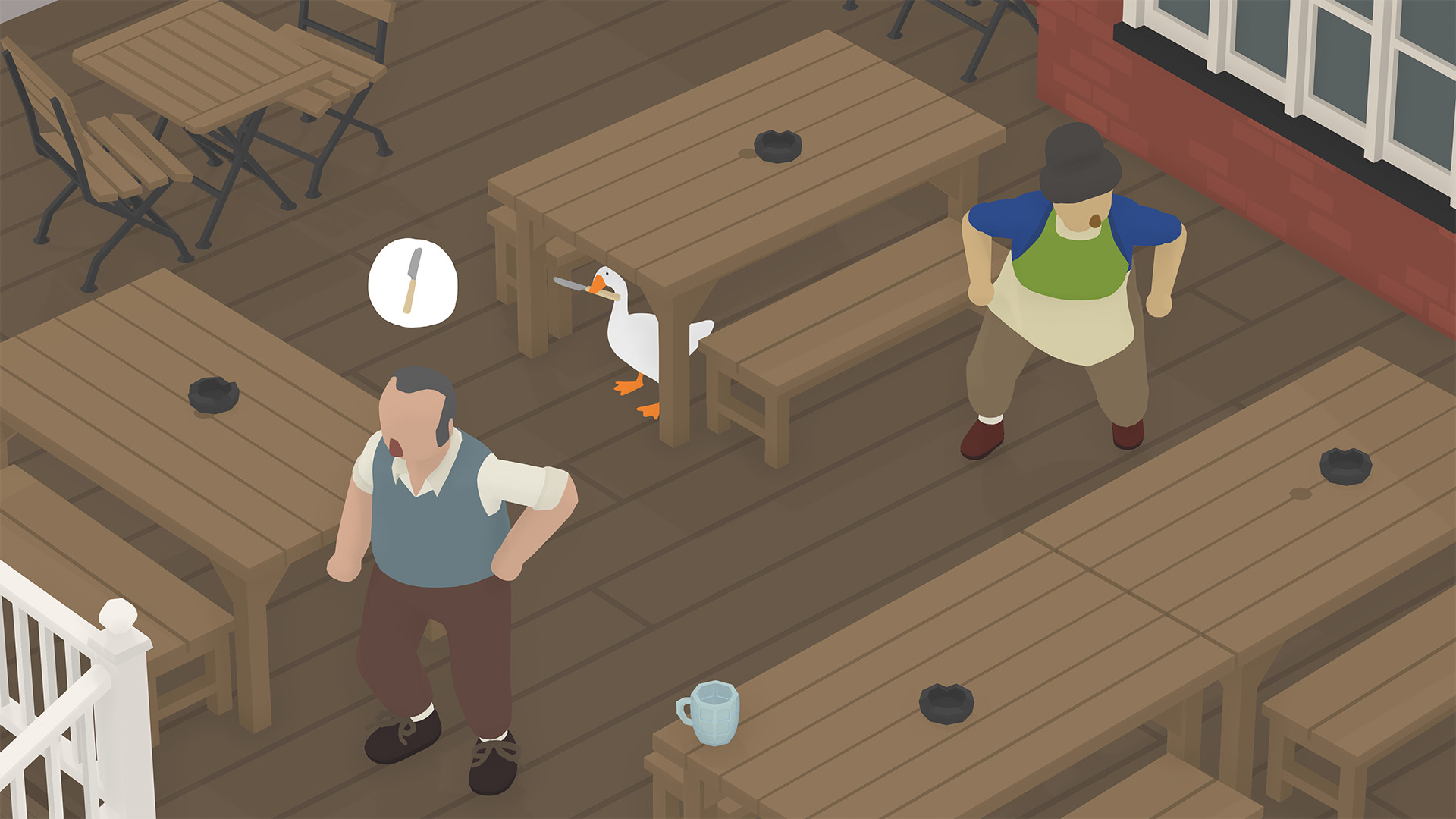
At the same time, the game gives us plenty of freedom to experiment. Many of the best moments don't happen because we follow the main objectives, but because we decide to test an absurd idea and see what happens. It's one of those games that constantly rewards the player's curiosity and creativity.
Even so, as I progressed, I began to feel some limitations. Although the premise is brilliant, the core mechanics don't evolve much over the adventure. We essentially keep doing the same things in different settings and, inevitably, there's a point where the initial novelty begins to fade.
I also found some puzzles to be somewhat inconsistent in difficulty. While certain objectives are intuitive and fun to solve, others depend more on trial and error, or on figuring out exactly what the game expects us to do. It never becomes frustrating, but there are moments when the logic of the solutions isn't as clear as it could be.
The campaign's length is another aspect that may divide opinion. On one hand, the game never drags on to the point of becoming tiresome. On the other, when the credits appear, there's a lingering sense that there was room for more content, more areas to explore, and more creative ways to cause trouble.
Then again, perhaps that feeling is itself a compliment. After all, we rarely finish something wishing for more when we weren't having fun. In my case, I genuinely wanted to keep spreading chaos through new settings and discover what other absurd situations the creators might have imagined.
In the end, Untitled Goose Game stands out precisely because it's different. In a market full of games constantly trying to be bigger, more complex, or more ambitious, this one chooses a completely distinct path. It presents a simple idea, executes it with enormous confidence, and manages to draw smiles from practically beginning to end.
It isn't a perfect game, and it could have benefited from a greater variety of mechanics or a slightly longer runtime. But that doesn't erase what it does so well. It's fun, creative, full of personality, and absolutely memorable.
Above all, it's a celebration of the purest, most innocent chaos possible. And after a few hours tormenting innocent villagers, it's impossible not to admit one thing: being a goose is a lot more fun than it looks.
out of 10
Pros
| Cons
|
Game Untitled Goose Game Released 2019 Available on PC · macOS · PlayStation 4 · Xbox One · Nintendo Switch Reviewed on PlayStation 4 |  Cover: IGDB |
| PL | Pedro Lopes Writer · Portugal |
A games writer from Portugal running on a highly irresponsible amount of coffee — his blood type is officially "espresso". He has been a content creator at Lisbon Games Week, a jury member at Over & Out ’25 and an attendee of DevGAMM Lisbon 2025 (mostly for the free coffee). He has a Pac-Man tattoo on his finger, which contractually obliges him to chase ghosts forever.