
Neversong is one of those games that arrives without much fanfare, passes unnoticed by most people, and ends up surprising those who give it a chance. It isn't a gigantic production, nor does it try to compete with the industry's biggest names. On the contrary, it bets on a more intimate approach, focused on atmosphere, narrative, and the emotions it manages to convey to the player over the course of a few hours.

And perhaps it's precisely that simplicity that makes it so special.
At first glance, Neversong may look like just another 2D indie platformer with a peculiar art direction. But push a little further into the story and you realize there's something deeper hidden beneath its almost innocent appearance.
The adventure puts us in the shoes of Peet, a young boy who wakes from a coma and discovers the world around him has changed drastically. His friend — or perhaps something more than that — Wren has disappeared without a trace, and the other children of the small town seem equally entangled in an increasingly disturbing mystery.
What begins as a simple rescue mission quickly transforms into an emotional journey loaded with symbolism and interpretation.
One of the qualities I appreciated most in Neversong was precisely how it tells its story. The game never hands over all the answers directly. There are events, characters, and moments that seem deliberately left open to the player's interpretation.
For some people, this might be a source of frustration. For me, it ended up being one of its greatest strengths.
I like when a narrative trusts the player's intelligence and allows each person to draw their own conclusions. Neversong does that constantly. There are several layers of meaning throughout the adventure, and many of its themes are presented through metaphor and symbolism rather than literal explanations.
When the final credits appeared, I found myself thinking for quite a while about what I had just experienced. And that kind of impact rarely happens by accident.
The themes it tackles are surprisingly heavy for a game with this visual presentation.
Depression, trauma, guilt, loss, and grief are among the narrative's central elements. These are delicate subjects, but they're handled with admirable sensitivity. The game never seeks easy shock value or excessive dramatization. Instead, it builds a melancholic atmosphere that accompanies practically the entire journey.
Peet's story works both as a dark fantasy adventure and as an emotional representation of deeply human internal processes.
It's precisely that duality that makes the narrative so interesting.
Visually, Neversong has an identity all its own.
The first comparison that came to mind was, inevitably, the work of Tim Burton. The characters have exaggerated proportions, the settings carry a tone that's simultaneously charming and unsettling, and there's a constant feeling of strangeness that fits the narrative perfectly.
Each area has its own personality and contributes to building that atmosphere of a restless dream that characterizes the whole adventure. We aren't looking at technologically impressive graphics, but at a strong, coherent art direction.
And very often, that matters far more.
The atmosphere the game creates is excellent.
There's always a sense of subtle discomfort during exploration. We never know exactly what we'll find in the next area, and even the apparently calmest moments carry a strange melancholy.
It's a world that constantly sparks curiosity.
The gameplay combines platforming, exploration, small puzzles, and combat in a fairly balanced way.
Nothing here tries to reinvent the genre. The controls are simple, accessible, and behave exactly as expected. We jump between platforms, solve environmental challenges, and use our bat to face the different enemies that appear along the way.
Combat is relatively basic, but I never felt that was a problem.
In fact, the simplicity ends up benefiting the experience. The main focus is clearly on the narrative and the atmosphere, and the combat systems serve their purpose well without becoming overly complex or intrusive.
Boss battles deserve a special mention.
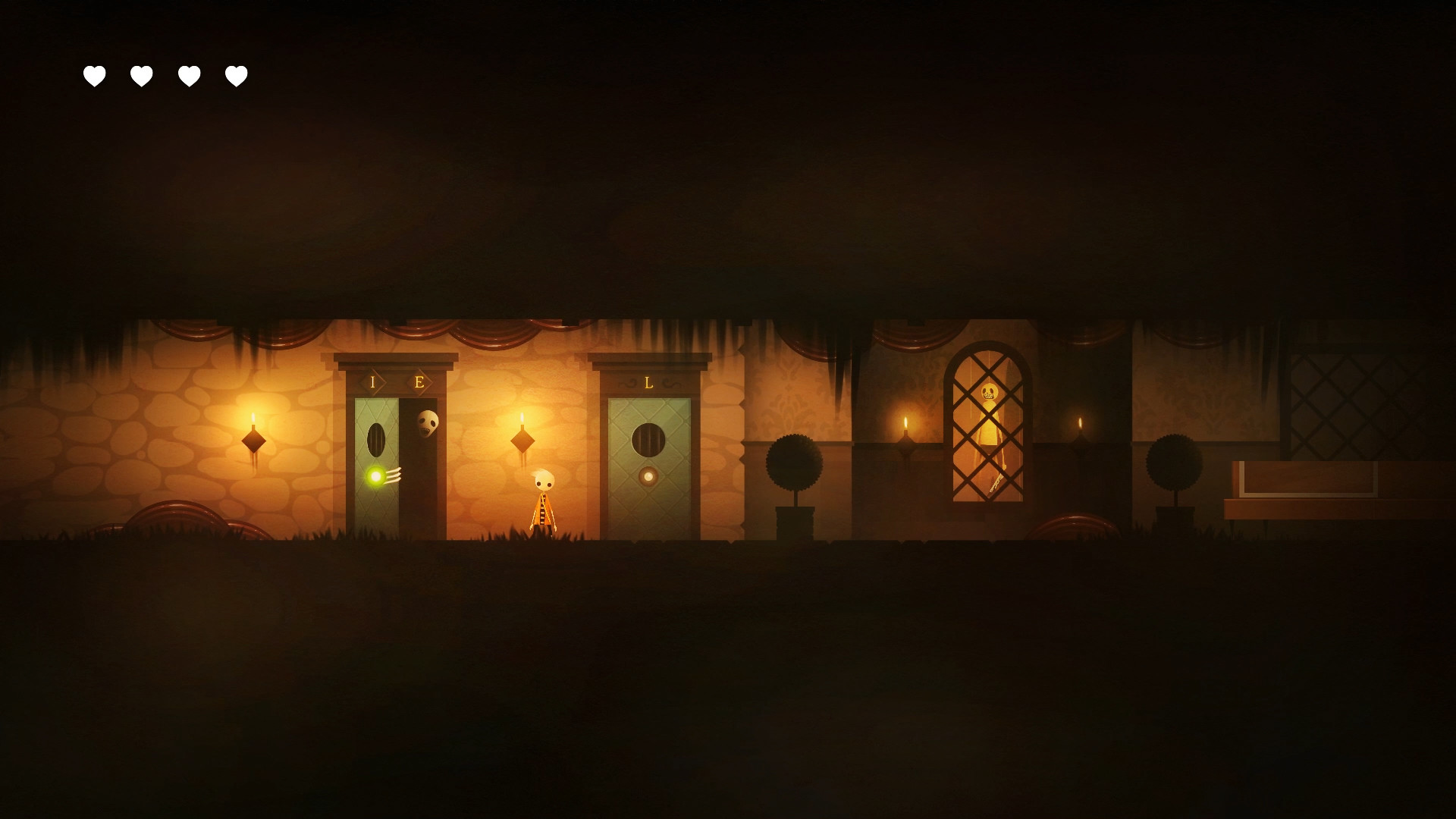
Although they aren't particularly difficult, they feature creative designs and contribute to the adventure's surreal tone. Many of these encounters work almost like physical representations of the emotional themes explored by the narrative, which gives them a meaning beyond the simple mechanical challenge.
Exploration is also enjoyable and encourages the player to uncover little secrets scattered across the scenery.
That said, it was precisely in this area that I felt some limitations.
At times, I had the feeling the game could have developed some of its ideas further. There are interesting characters who receive little screen time, areas that could have been explored in more depth, and narrative concepts that end almost as quickly as they begin.
It's a criticism born more from the desire to have had more content than from any serious problem.
Because the truth is, I liked that world so much that I simply wanted to spend more time in it.
The soundtrack also deserves plenty of praise.
The compositions perfectly match the adventure's melancholic tone. There are moments when the music nearly disappears, leaving room for silence and reflection. In others, it takes on a more emotional role and reinforces the impact of certain scenes.
It's a discreet but extremely effective score.
It never tries to steal the spotlight from the narrative, but it's constantly present to reinforce what we feel during the journey.
And perhaps that's the best way to describe Neversong as a whole.
It's a subtle game.

It doesn't try to impress through grand cinematic moments, revolutionary mechanics, or dozens of hours of content. It prefers to tell a personal, emotional story that's open to interpretation, creating an experience that stays with us long after we've finished the adventure.
Its short length — around three to four hours — may seem like a limitation for some players. But honestly, I never felt like I was being rushed. The experience ends before it starts repeating itself and maintains a consistent pace from beginning to end.
Of course, I would have liked to explore more of that world and delve deeper into some narrative elements. But maybe part of the charm lies precisely there.
Like many of the themes it addresses, Neversong leaves some things unsaid.
And it's that ambiguity that keeps it echoing in your memory.
In the end, Neversong is a small indie gem that deserves far more attention than it received — a short, emotional, and visually distinct adventure that tackles difficult themes with sensitivity and intelligence.
It may not answer all the questions it raises.
But it does something perhaps more important: it gives us reasons to keep thinking about them long after the game is over.
out of 10
Pros
| Cons
|
Game Neversong Released 2019 Available on PC · PlayStation 4 · Xbox One · Nintendo Switch · iOS Reviewed on Nintendo Switch |  Cover: IGDB |
| PL | Pedro Lopes Writer · Portugal |
A games writer from Portugal running on a highly irresponsible amount of coffee — his blood type is officially "espresso". He has been a content creator at Lisbon Games Week, a jury member at Over & Out ’25 and an attendee of DevGAMM Lisbon 2025 (mostly for the free coffee). He has a Pac-Man tattoo on his finger, which contractually obliges him to chase ghosts forever.