
Let me start by admitting something that probably won't be unanimous among series fans: Assassin's Creed Mirage is, quite possibly, my favorite Assassin's Creed.
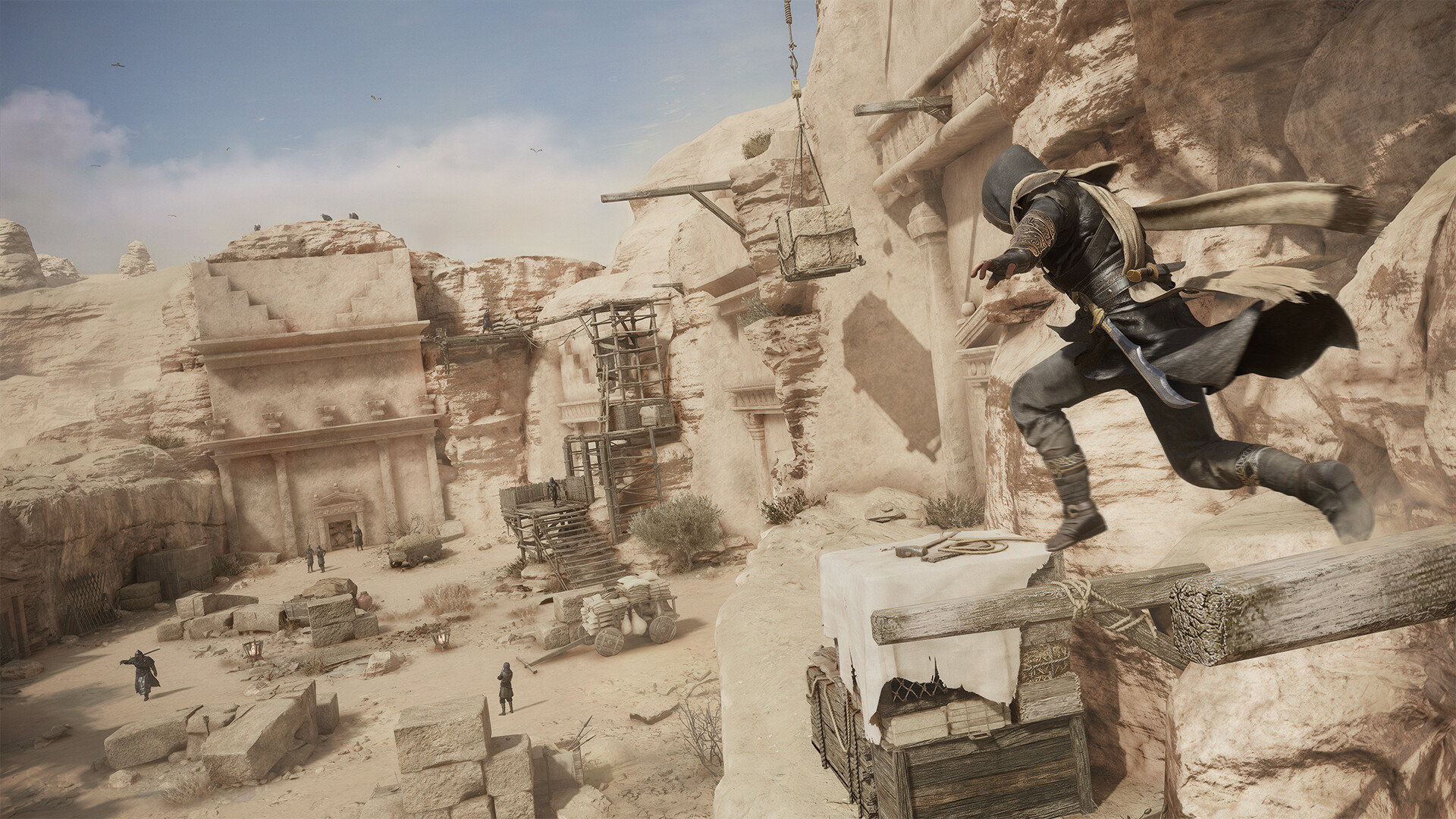
I know full well that's an opinion likely to spark some debate. After all, we're talking about a franchise that includes such landmark titles as Assassin's Creed II, Brotherhood, Black Flag, and even Origins. However, after finishing Mirage, I was left with a feeling I hadn't had in a long time with the series: that of playing a true Assassin's Creed.
Maybe part of that comes down to how much time had passed since I played some of the classics. Maybe there's also a nostalgia factor tied to the return of certain mechanics. But regardless of all that, the truth is that Mirage won me over in a way few games in the franchise ever have.
Ubisoft's greatest merit was understanding that not every player was looking for ever-bigger experiences, with gigantic maps and hundreds of hours of content. After the most recent trilogy — made up of Origins, Odyssey, and Valhalla — Mirage arrives as a kind of return to the roots, recovering many of the elements that defined the series' earliest games.
And it works surprisingly well.
From the very first minutes, there's a familiar feeling. The focus returns to stealth, to moving across rooftops, to planned assassinations and urban exploration. Instead of vast territories spread across dozens of regions, we get one city carefully built to serve as a playground for assassins.
And what a city.
Baghdad is, without a doubt, one of the game's biggest stars.
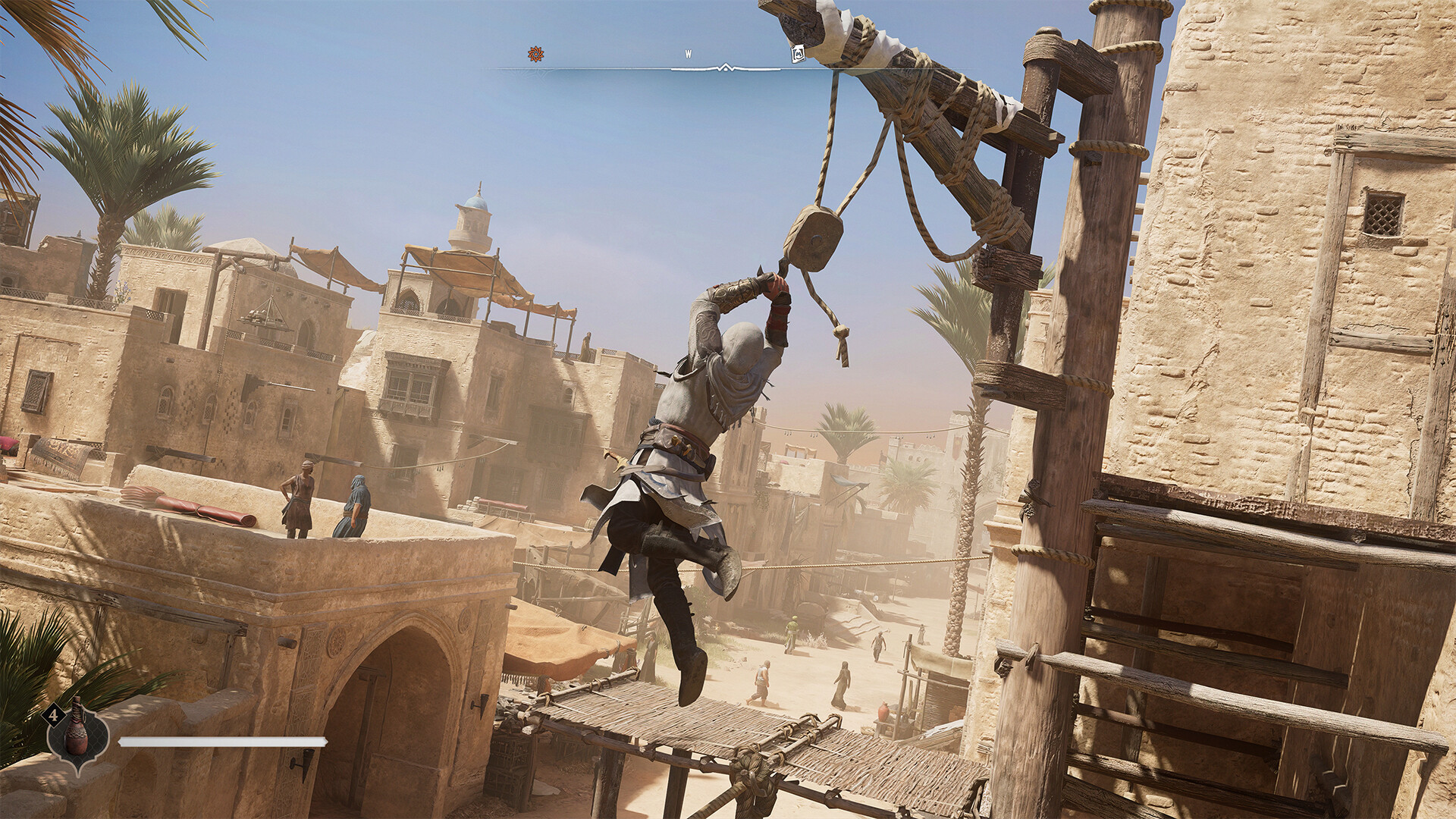
Rarely have I felt such a strong urge to explore an Assassin's Creed setting purely out of curiosity to better know the place where the story unfolds. The city is full of life — busy markets, narrow streets, distinct neighborhoods, and a fascinating architecture that turns every play session into a small trip back in time.
The historical reconstruction work is impressive.
Throughout the adventure I caught myself several times simply stopping to look at the world around me. There's an authenticity and care in the details that makes Baghdad much more than a simple map for completing objectives. It's a place that sparks genuine curiosity.
In fact, one of the biggest proofs of that work's success is what happened after I finished the game.
Mirage led me to research more about Baghdad, about the Islamic Golden Age, and about several of the historical events that inspired the game. Not every title manages to spark that kind of interest beyond its own narrative universe, and I consider that an enormous compliment to the work done by the development team.
But if Baghdad is fantastic, the narrative also deserves plenty of recognition.
It's one of the series' stories that managed to grip me the most in recent years. It may not have the epic scale of other franchise chapters, but it makes up for that with a much greater focus on characters and personal conflicts.
Basim's story works precisely because it's more intimate.
Over the course of the adventure we follow his evolution, his internal conflicts, and the doubts that accompany him as he tries to understand who he really is. There's an emotional depth we don't always find in the series' protagonists, which makes his journey particularly interesting.
Basim ended up becoming one of my favorite Assassin's Creed protagonists.
He has charisma, he has complexity, and he has a presence that easily distinguishes him from many other characters in the franchise. The way the narrative explores his personality and his dilemmas helps create a stronger bond with the player — something that doesn't always happen in games of this size.
And then there's the plot twist.
Without going into spoilers, it was one of those moments that genuinely caught me off guard and made me look at several earlier events from a completely different perspective. It's the kind of revelation that adds value to the narrative and rewards those who pay close attention to the story.
The gameplay also benefits greatly from this more focused approach.
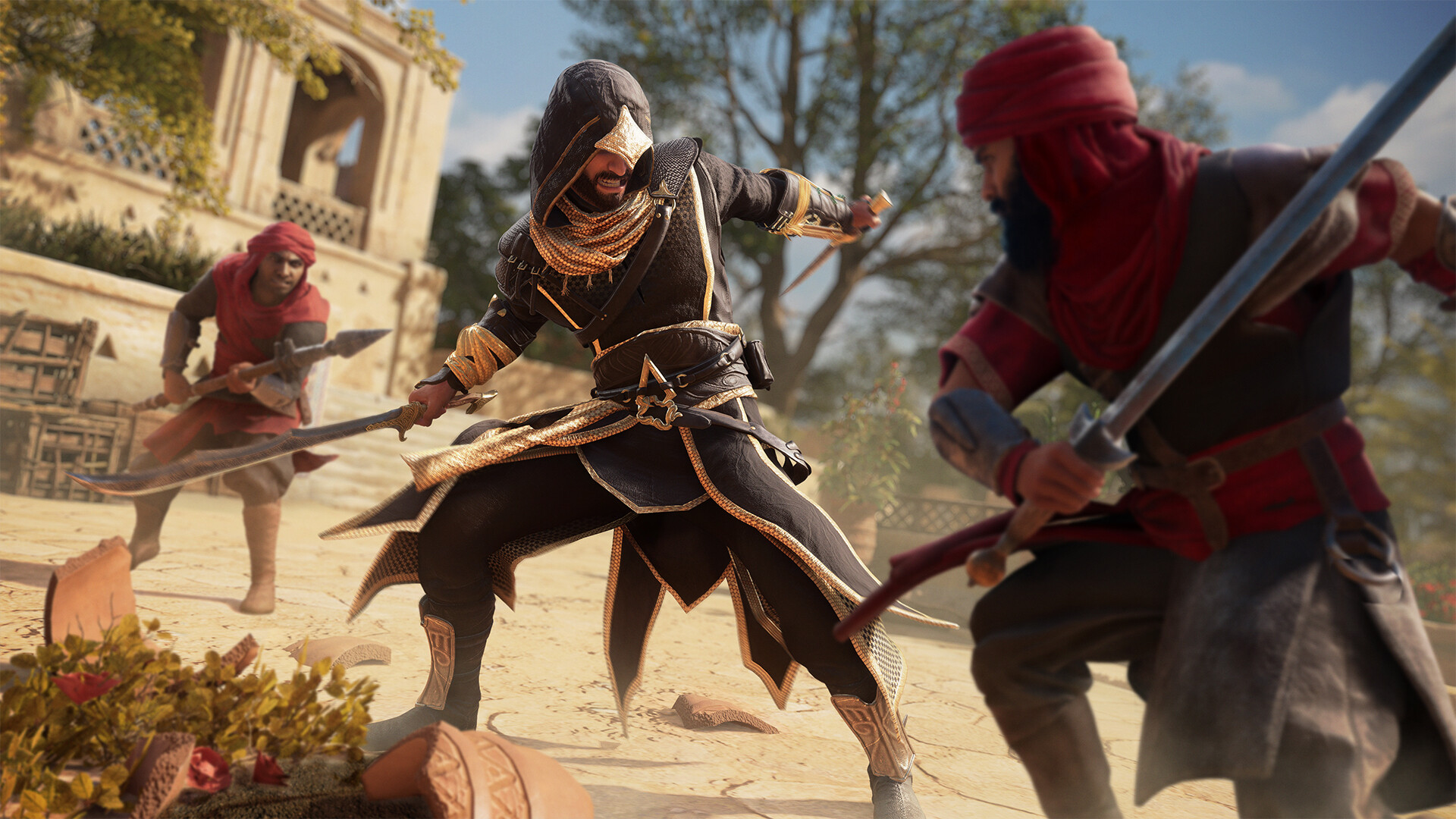
Stealth returns to a central role, and that was something I loved. Watching patrol routes, planning infiltrations, using tools to create distractions, and eliminating targets without being detected once again became as important as it should be in an Assassin's Creed.
The parkour, while not fully matching the fluidity of the older chapters, works well thanks to the city's design. Baghdad was clearly built with vertical movement in mind, making exploration far more enjoyable than in many of the recent games.
There's an interesting balance between tradition and modernity.
Mirage brings back several classic ideas from the series without completely ignoring what the more recent titles taught. The result is an experience that can please both those who missed the early Assassin's Creed games and those who appreciated the evolution introduced by the more recent RPG entries.
Of course, it isn't a perfect game.
There are some visible budget limitations when compared to Ubisoft's biggest releases. Certain animations could be more refined, some side missions are less than memorable, and there are moments when the game seems to play things a little too safe.
But none of those issues was enough to dampen my enthusiasm during the adventure.
In the end, Assassin's Creed Mirage achieved something I no longer expected from the series: it made me fall in love with the classic formula all over again.
Without needing a gigantic map, without dozens of complex systems, and without an endless runtime, it delivered a focused, engaging experience that's extremely faithful to what made Assassin's Creed special in the first place.
It may not be the best Assassin's Creed for everyone.
But for me, it was the game that struck the best balance between the franchise's past and present.
And when I finished Basim's adventure and left Baghdad behind, I was left with a rare feeling: the immediate urge to start it all over again.
out of 10
Pros
| Cons
|
Game Assassin's Creed Mirage Released 2023 Available on PC · PlayStation 4 · PlayStation 5 · Xbox One · Xbox Series X|S · iOS Reviewed on Xbox Series X|S |  Cover: IGDB |
| PL | Pedro Lopes Writer · Portugal |
A games writer from Portugal running on a highly irresponsible amount of coffee — his blood type is officially "espresso". He has been a content creator at Lisbon Games Week, a jury member at Over & Out ’25 and an attendee of DevGAMM Lisbon 2025 (mostly for the free coffee). He has a Pac-Man tattoo on his finger, which contractually obliges him to chase ghosts forever.